
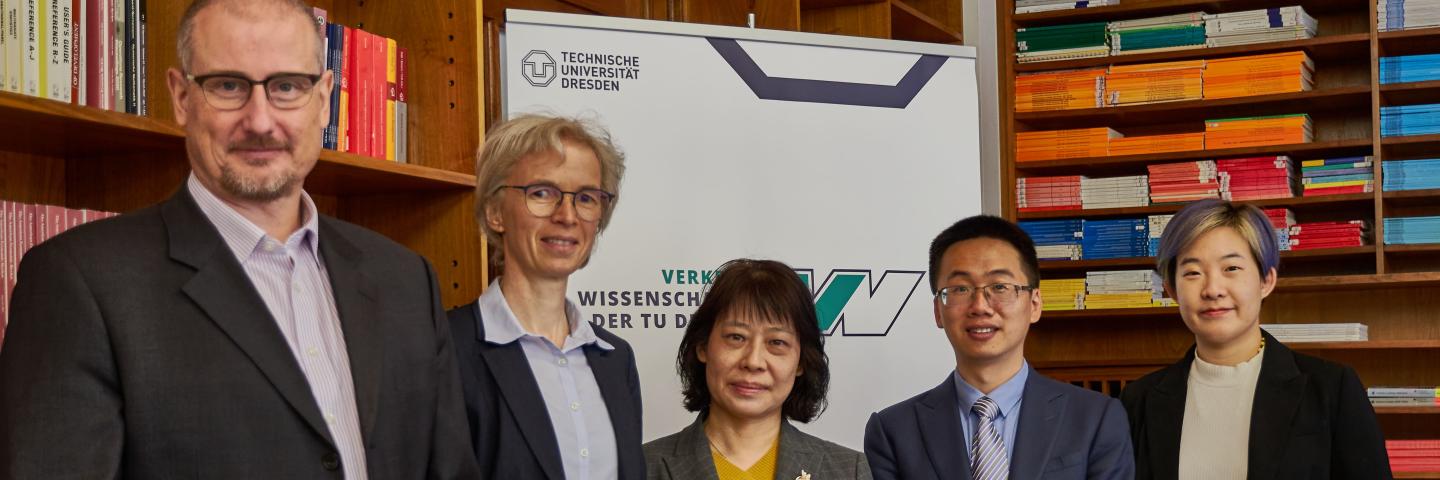
Transport sciences in Dresden and Beijing cooperate
For two years, the “Friedrich List” Faculty of Transport and Traffic Sciences has been cooperating with the Faculty of Transport at Beijing Jiao Tong University (Beijing). In the field of Transportation and Traffic Sciences the BJTU is one of the best universities in the world: In the category ‘Transportation Science & Technology’ of the international Shanghai University Ranking it is ranked first. For a long time, the contact between TUD and BJTU was limited to exchanges via telephone and video conference due to the pandemic. Now the Dresden faculty had the pleasure of welcoming and hosting a Beijing delegation in Dresden.
Dresden Faculty of Transport and Traffic Sciences welcomes partner university from Beijing (BJTU)
On April 24, Dean Prof. Nie and Vice Dean Prof. Bai arrived at the TUD. For the first face-to-face meeting, the “Friedrich List” Faculty of Transport and Traffic Sciences introduced itself: One highlight was the demonstrations in the in-house laboratories. In addition to the exciting program on-site at the faculty and in Dresden, there was – above all – plenty of room for exchange and networking. Representatives from various chairs of the faculty discussed specific topics and talked about current projects and work with the delegation from Beijing. Finally, there was extensive discussion on how to further deepen the cooperation in research and teaching. After three enriching days, the Beijing delegation said their goodbyes.
Cooperation - What is to come?
The cooperation between the “Friedrich List” Faculty of Transport and Traffic Sciences at TUD and the Faculty of Transportation at BJTU includes versatile programs and projects. The following focal points are planned in their cooperation:
- Short-term student exchange programs: annually up to 4 students spending 1 semester at the partner university
- Mutual recognition of degrees and achievements/credits